

My Room
My Room
Exhibition series in display of Lithuanian art of the
first half of the 20th century
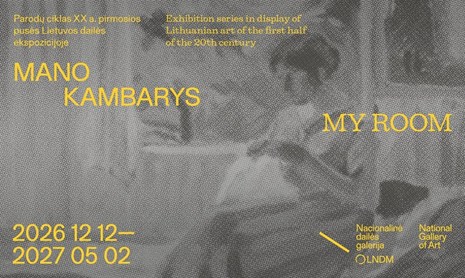
My Room is a visual conversation about the private spaces that surround us and their relationship to human identity, memory and imagination. Rooms tell stories about their times, the people who inhabited them and their ways of seeing the world. Yet even a real space takes on a different life in a work of art: the artist's gaze transforms it, sometimes rendering it almost unrecognisable. The room becomes not only a witness to life but also a work of art in its own right.
The exhibition brings together works by artists active in Lithuania during the first half of the twentieth century, in which depictions of interiors (or fragments of them) reveal different social and cultural worlds. Rooms in manor houses are often arranged as museums preserving the historical memory of families and regions; the peasant cottage becomes an image of cultural tradition, while the artist's studio becomes a space of creative identity. As society modernises, notions of private life also change, and the home becomes increasingly associated with individual taste, personal freedom and self-expression. For artists, particularly women, having a room of their own also meant the opportunity to work and create independently. In her 1929 essay A Room of One's Own, Virginia Woolf wrote: 'A woman must have money and a room of her own if she is to write fiction. 'This idea remains just as relevant today.
Depictions of interiors are a relatively unusual feature of
Lithuanian art from the first half of the twentieth century, yet
they offer a fresh perspective on the oeuvres of well-known
artists. In works by Ferdynand Ruszczyc, Sofija
Dembovskytė-Romerienė, Vladas Didžiokas, Vytautas Kairiūkštis,
Vladas Drėma and others, the room becomes both a subject of
representation and a distinctive way of seeing the world, sometimes
even providing an impetus for artistic experimentation. The
exhibition also features furniture models by Jonas Prapuolenis from
the Soviet period and contemporary artist Liudas Parulskis's
interpretation Golden Half-Hour of Ferdynand Ruszczyc's
Golden Room. These works complement the images from the
early twentieth century and create a dialogue between different
periods, while Parulskis's interpretation invites visitors to
experience the celebrated painting anew.
Curator Algė Andriulytė
Coordinator Gabrielė Radzevičiūtė
Architect Mindaugas Reklaitis
Designer Ugnė Balčiūnaitė
Exhibition organizer Lithuanian National Museum of Art, National Gallery of Art
Works on loan from: M. K. Čiurlionis National Museum of Art, Dr Jaunius Gumbis LithuanianArt Collection, Lithuanian Archives of Literature and Art, Liudas Parulskis
Special thanks to: Genovaitė Bartulienė, Iveta Dabašinskienė, Irena Dobrovolskaitė, Viktoras Liutkus, Jūratė Meilūnienė, Aušrinė Ruzgytė, Vadim Šamkov
