
The Artificial Mind
The title "Artificial Mind" references Claude Lévi-Strauss' The
Savage Mind (1962), in which he argues that "savage" and
"civilized" thought share the same epistemological architecture -
differing not in structure but in mode of operations. While the
"civilized" engineer works with purpose- built tools toward a
specific end, the "savage" bricoleur thinks with whatever is at
hand, constructing new meanings from fragments.
With the advent of AI, we might speak of a new variation of
thought - the Artificial Mind - that confounds this distinction.
Though AI is typically figured as the apotheosis of engineering,
what it actually does resembles bricolage far more closely:
repurposing and recombining existing anthropogenetic materials into
heterogeneous assemblages rather than engineered constructions.
More fundamentally, the Artificial Mind points to the technicality
of thought itself - no longer an autonomous, interior human
faculty, but an operational process structured by historically and
materially situated practices.
Unsurprisingly, AI has provoked philosophy - across both its
analytic and continental branches - into responses, reflections,
and reservations ranging from careful conceptual revision to
outright alarm. Perception, judgement, agency - domains previously
considered exclusive to human reasoning - are now contested
terrain. Phenomenology asks how mediation by artificial neural
networks alters the fundamental structures of experience; ethics
becomes concerned with the conditions of moral formation when the
environments that shape us become generative; while political
philosophy delves into what institutional settings are required
when the very capacities of judgement become increasingly
automated.
The conference invites theoretical and empirical contributions on
the tectonic transformations AI has introduced into the conceptual
space of the post- - at least insofar as it pertains to the human.
Conceptually, this rethinking necessitates a shift from
anthropology toward postanthropology - at once a
postanthropocentric revision of disciplines confronted with a
non-human form of thought, and a broader interrogation of the
Anthropos as the presumed center of agency, knowledge, and
meaning-making.
This rethinking is not without tensions. The apparent radical
alterity of the artificial mind remains deeply embedded in
all-too-human systems - and is therefore inescapably implicated in
their structures and mechanisms of exploitation, extraction, and
control: capitalism, patriarchy, and colonialism, among others.
The programme of the conference is here.
Organizer: Lithuanian Culture Research
Institute
Partners: National Gallery of Art, Vytautas
Magnus University
Organizing committee: Danutė Bacevičiūtė,
Kęstutis Mosakas, Laurynas Norus, Denis Petrina, Justas Petronis,
Augustas Pinkevičius, Aistis Žekevičius, Audronė Žukauskaitė
11:00 - 17:00
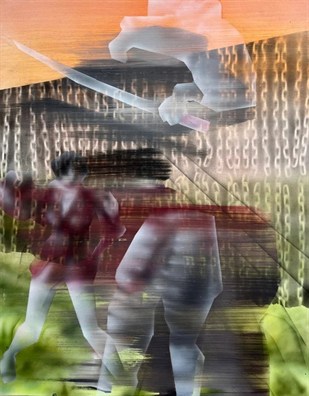
The Artificial Mind. Art and Philosophy after AI - an international conference on 24-25 September 2026 at the National Gallery of Art.
